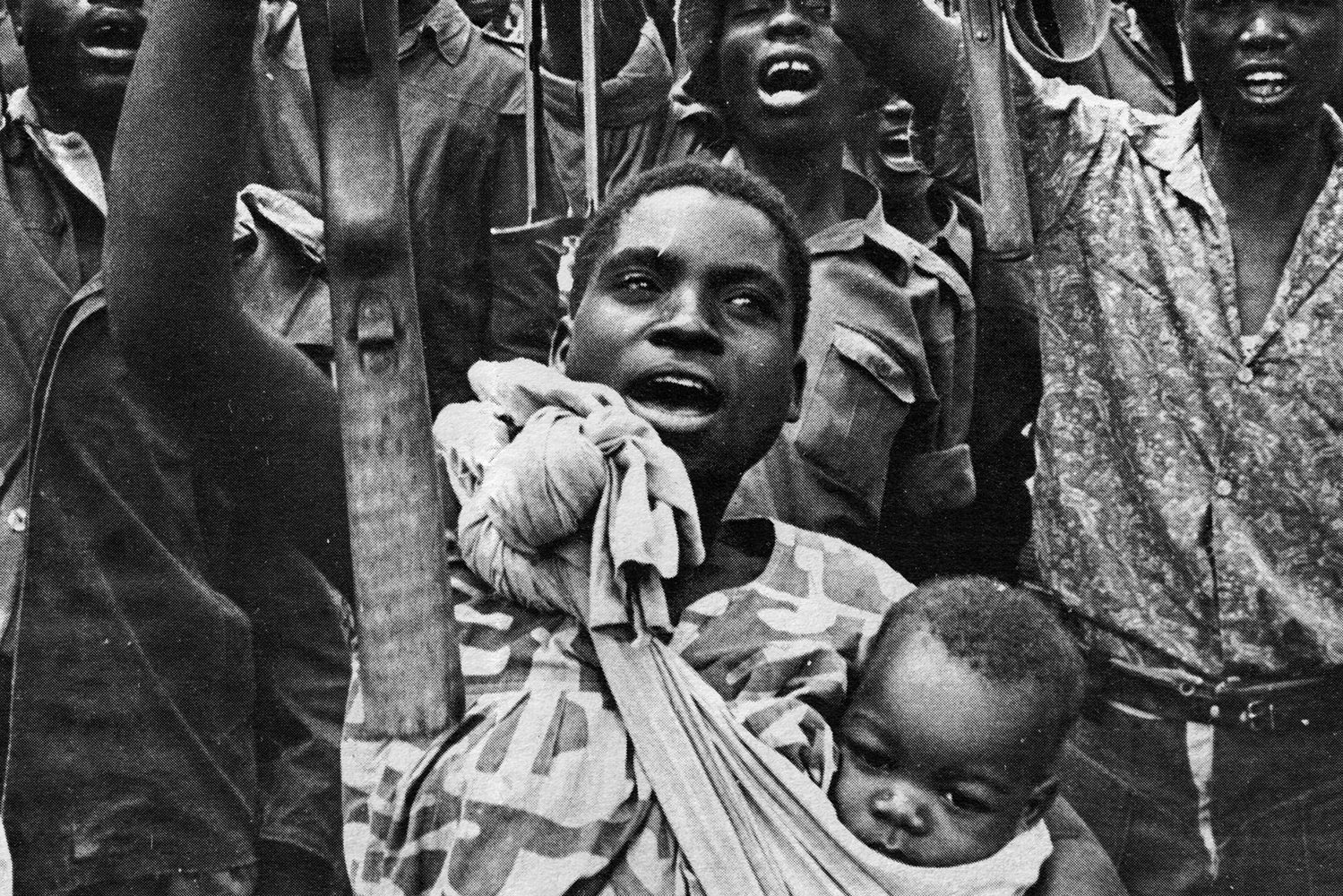

Préface à des fusils pour Banta se concentre sur le film perdu Des fusils pour Banta (1970), premier long métrage de la réalisatrice Sarah Maldoror. Tourné en République de Guinée, le film suit la vie et la mort prématurée d’Awa, une jeune paysanne engagée dans le Parti africain pour l’indépendance de la Guinée et du Cap-Vert (PAIGC). Parallèlement à ce récit semi-fictionnel, le film utilise des images de l’implication des femmes et des enfants dans la lutte.
Financé par l’armée algérienne qui souhaitait en faire un outil de propagande, le film a été confisqué à Maldoror qui exigeait un contrôle total sur le montage. À ce jour, les bobines n’ont été ni identifiées ni restituées. De Des fusils pour Banta, il reste cependant une collection de photographies prises par Suzanne Lipinska pendant le tournage et des souvenirs fragmentés de Sarah Maldoror, recueillis par Abonnenc au cours de deux années de conversations avec la cinéaste.
Avant-propos rétrospectif d’un film absent, Abonnenc cherche ici à reconstituer le récit de Des fusils pour Banta et interroge les figures de la militante, de la réalisatrice, des photographe, en s’arrêtant sur leurs fonctions respectives dans la fabrication d’une révolution. S’exprimant à partir de ces différentes positions, les voix-off mettent en lumière la relation entre révolution et production culturelle dans le contexte de la décolonisation de l’Afrique, mais aussi la distance qui nous sépare ou nous relie à ces projets révolutionnaire. La juxtaposition d’images d’archives, de textes écrit par l’artiste proposent une réflexion située, temporaire, sur l’héritage de l’image militante et la position du témoin.
Préface à des fusils pour Banta focuses on the lost film Des fusils pour Banta (1970), director Sarah Maldoror’s first feature film. Shot in the Republic of Guinea, the film follows the life and untimely death of Awa, a young peasant woman involved in the African Party for the Independence of Guinea and Cape Verde (PAIGC). Alongside this semi-fictional narrative, the film uses images of women and children involved in the struggle.
Funded by the Algerian army, which wanted to use it as a propaganda tool, the film was confiscated from Maldoror, who demanded total control over the editing. To date, the reels have not been identified or returned. However, what remains of Guns for Banta is a collection of photographs taken by Suzanne Lipinska during filming and fragmented memories of Sarah Maldoror, collected by Abonnenc during two years of conversations with the filmmaker.
A retrospective foreword to a missing film, Abonnenc seeks to reconstruct the narrative of Des fusils pour Banta and examines the figures of the activist, the director and the photographer, focusing on their respective roles in the making of a revolution. Speaking from these different positions, the voiceovers highlight the relationship between revolution and cultural production in the context of African decolonisation, but also the distance that separates or connects us to these revolutionary projects. The juxtaposition of archive images and texts written by the artist offers a situated, temporary reflection on the legacy of the militant image and the position of the witness.
Entrée libre
Festivals :
- DocumentaMadrid 2019
- IndieLisboa 2021
- Decolonial Film Festival 2025
Revue de presse :
- Écouter les artistes : Mathieu Kleyebe Abonnenc raconte Préface à des fusils pour Banta – Soundcloud – par le FRAC